The deaths of three people with ties to the U.S. consulate over the weekend is making Juárez the focal point for the deadly violence that has gripped Mexico for the past two years.
As the pressure mounts to solve the slayings, the United States and Mexico have sent top investigators to work hand in hand to find the killers.
On Monday, Mexican officials said they suspect that the powerful and violent Aztecas gang is behind Saturday's fatal shootings, which President Barack Obama and Mexican President Felipe Calderón vigorously condemned.
U.S. and Mexican officials have not determined the motives in the deaths of Lesley A. Enriquez, 34, who worked for the consulate and was four months pregnant; her husband, Arthur H. Redelfs, 30, a detention officer for the El Paso County Sheriff's Office; and Jorge Alberto Salcido Ceniceros, 36, whose wife worked for the consulate.
But Juárez Mayor Jose Reyes Ferriz said Monday that he was told in police briefings that the Aztecas, who provide the muscle to the Juárez drug cartel, are responsible for the slayings.
Mexican officials also confirmed that U.S. agencies -- including the FBI; Drug Enforcement Administration; Immigration and Customs Enforcement; Bureau of Alcohol, Tobacco, Firearms and Explosives; and Sheriff's Office -- are assisting.
Mexican federal Attorney General Arturo Chavez Chavez arrived Monday in Juárez to discuss the investigation with law enforcement and military officials. They are expected to update Calderón on any progress during his visit to Juárez today.
U.S. officials would not discuss any investigation details, but they and Mexican officials said the Aztecas gang is affiliated with the Carrillo Fuentes drug cartel. As foot soldiers for the cartel, they have carried out numerous murders, kidnappings, arsons, extortions and drug and arms trafficking.
The gang also has connections with the Barrio Aztecas in El Paso, a brother organization. Two years ago, the FBI spearheaded an investigation that led to the convictions of several Barrio Azteca leaders and proved their ties to the Juárez drug cartel.
Last year, Eduardo "Tablas" Ravelo, presumed leader of the Barrio Aztecas, was placed on the FBI's Most Wanted fugitives list. He is believed to be hiding in Mexico, and a former gang member testified that he controlled the gang's operations in Juárez.
According to Mexican police reports, the victims died within short distances of a children's party they attended and within 22 minutes of each other. Dispatchers reported the attack against Salcido at 2:20 p.m. and the attack against Redelfs and Enriquez at 2:42 p.m.
The party took place at the Barquito de Papel (Paper Ship), an events hall in the 4700 block of Insurgentes. A woman who answered the phone at the hall on Monday said investigators had stopped by to interview employees.
"We told them we don't know if (the consular) employees were here, because there were a lot of people, at least 100," said the woman who would not give her name.
Redelfs and Enriquez were in a white vehicle, and Salcido also drove a white vehicle. Both vehicles had children in them.
Monday, Juárez city firefighters treated as suspicious a vehicle fire at Malecon and Plutarco Calles, about four miles from where Redelfs and Enriquez were killed. Authorities said the Ford Explorer was reported stolen last month.
Witnesses told police a light-colored Ford Expedition or Explorer with armed men followed the U.S. couple's white Toyota near the intersection of 5 de Mayo and Malecon. The Toyota was hit with multiple gunshots from at least one 9 mm firearm, and came to a stop after crashing in front of Juárez City Hall. The government building is about 300 feet from the Stanton Street bridge.
Information on the vehicle that followed Salcido was not available. Police said his attackers used an AK-47 to spray his white Honda with bullets when he was at Articulo 39 and Insurgentes, the same street as the party hall.
The slayings drew swift reactions from Mexican and U.S. officials, who vowed to solve the killings.
Obama said in a statement that he was outraged by the brutal slayings, and Secretary of State Hillary Rodham Clinton said the U.S. would do what it could to protect State Department employees in Mexico.
More than 4,700 people have been killed in Juárez since 2008, when rival drug cartels began their brutal battle for control of the Juárez drug-trafficking corridor.
In Mexico, the death toll has been put at more than 15,000.
In another slaying over the weekend in Juárez, El Paso resident Juan Ramos was killed early Sunday. He was at the Billares Pockets sports club on Avenida Torres and Palacio de Mitla when several armed men stormed in and began shooting at everyone. Three people were killed and seven others were injured in the attack.
His wife, Brenda Ramos, said she last heard from him on Saturday evening, when he called from Juárez to let her know he would be staying there longer to watch a boxing match on TV with his friends.
Her last words to him were to "take care."
"I told him to be careful because of all the violence that is happening over there, to come home early. He said he would be fine," she said. "He told me he would be all right. I told him take care, and then he told me that I should take care, too."
Brenda Ramos said her husband was a good man who worked hard to provide for his five children. He also took care of his mother and a sister, she said.
"I'm still in shock. I don't know what I feel," she said. "I still think he's going to walk through the front door."
In light of the latest deaths, Texas Gov. Rick Perry on Monday called on the federal government to take action to prevent spillover violence on U.S. soil.
"How many Americans will have to die before our federal government takes serious action along the Texas-Mexico border?" he asked. "The federal government must immediately take steps to increase resources along the border to protect American lives."
Wednesday, March 17, 2010

Texas Gov. Rick Perry orders activation of first phase of Texas spillover violence contingency plan
AUSTIN - Following the recent escalation of murders in northern Mexico and the increasing threat of violence crossing over into neighboring border communities in Texas, Gov. Perry today ordered the activation of the first phase of the state's spillover violence contingency plan. The state's plan is law enforcement sensitive and will not be released to the public for operational security purposes.
"With the growing threat of violence in Mexico spilling over the border, we have taken important measures to increase the law enforcement presence along the Texas border and have placed additional resources on standby to combat any potential situation," Gov. Perry said. "It is imperative that the federal government immediately provide additional resources to prevent spillover violence, but with the safety of Texans on the line, we can't afford to wait."
At the governor's direction, the Texas Department of Public Safety (DPS), in coordination with local and federal law enforcement along the Texas-Mexico border, has implemented critical elements of the state's spillover violence contingency plan. These steps include increased surveillance of border activity by state and local law enforcement, the Texas Border Security Operations Center, and the Joint Operational and Intelligence Centers to ensure the timely sharing of intelligence information; increased ground, air and maritime patrol presence; and increased intensity of day and night DPS helicopter patrol operations along the Rio Grande River, as well as National Guard helicopters to support aviation missions. Additional resources ready for rapid deployment have been placed on standby, including DPS SWAT Teams and Trooper Strike Teams, as well as Ranger Recon Teams prepared to reposition based on threat.
"Texas has a unique cultural and economic relationship with Mexico, and we are committed to a common interest of shutting down these criminal enterprises," Gov. Perry said. "We will continue to closely monitor this situation, and take any necessary action to ensure the safety of our citizens and to protect continued legitimate cross-border trade and travel."
Since January 2008, a reported 4,700 homicides have been committed across the border from El Paso in Ciudad Juarez, making it one of the most violent cities in the world.
A porous border places Texas and the nation at risk from international terrorists, organized crime cartels and transnational gangs. Until the federal government fulfills its responsibility of securing our border, Texas will continue filling in the gaps by putting more boots on the ground, providing increased law enforcement resources and leveraging technology along the border.
Gov. Perry has a standing request with the federal government for 1,000 Title 32 National Guardsmen to support civilian law enforcement efforts to enhance border security in Texas, as well as a more recent request for predator drones to be based in and operate over the Texas-Mexico border to provide essential information to law enforcement on the ground.
"With the growing threat of violence in Mexico spilling over the border, we have taken important measures to increase the law enforcement presence along the Texas border and have placed additional resources on standby to combat any potential situation," Gov. Perry said. "It is imperative that the federal government immediately provide additional resources to prevent spillover violence, but with the safety of Texans on the line, we can't afford to wait."
At the governor's direction, the Texas Department of Public Safety (DPS), in coordination with local and federal law enforcement along the Texas-Mexico border, has implemented critical elements of the state's spillover violence contingency plan. These steps include increased surveillance of border activity by state and local law enforcement, the Texas Border Security Operations Center, and the Joint Operational and Intelligence Centers to ensure the timely sharing of intelligence information; increased ground, air and maritime patrol presence; and increased intensity of day and night DPS helicopter patrol operations along the Rio Grande River, as well as National Guard helicopters to support aviation missions. Additional resources ready for rapid deployment have been placed on standby, including DPS SWAT Teams and Trooper Strike Teams, as well as Ranger Recon Teams prepared to reposition based on threat.
"Texas has a unique cultural and economic relationship with Mexico, and we are committed to a common interest of shutting down these criminal enterprises," Gov. Perry said. "We will continue to closely monitor this situation, and take any necessary action to ensure the safety of our citizens and to protect continued legitimate cross-border trade and travel."
Since January 2008, a reported 4,700 homicides have been committed across the border from El Paso in Ciudad Juarez, making it one of the most violent cities in the world.
A porous border places Texas and the nation at risk from international terrorists, organized crime cartels and transnational gangs. Until the federal government fulfills its responsibility of securing our border, Texas will continue filling in the gaps by putting more boots on the ground, providing increased law enforcement resources and leveraging technology along the border.
Gov. Perry has a standing request with the federal government for 1,000 Title 32 National Guardsmen to support civilian law enforcement efforts to enhance border security in Texas, as well as a more recent request for predator drones to be based in and operate over the Texas-Mexico border to provide essential information to law enforcement on the ground.
Calderon’s plan to “rescue” city
JUAREZ -- Mexican President Felipe Calderón on Tuesday offered his plan to "rescue" and "rebuild" the city, which has been plagued by 4,700 slayings since 2008.
His plan would attack poverty, improves education, health facilities and offers financial assistance to families in an effort to combat organized crime and the drug war that has turned Juárez into the most dangerous city in Mexico.
During his speech to several hundred people, Calderón mentioned the slayings Saturday of three people connected to the U.S. consulate.
He called their slayings "resentful, inadmissible and profoundly deplorable."
"Yes, my friends, the situation of violence and insecurity in Ciudad Juárez has to change. And to make those changes, among other things, is to fortify the mechanisms of justice and security, and also, change the social conditions of poverty and marginalization that exist and that are fertile ground for the crime and violence," he said.
On Saturday, gunmen killed Lesley A. Enriquez, 34, a U.S. citizen who worked for the U.S. consulate in Juárez; her husband, Arthur Redelfs, 36, a detention officer for the El Paso County Sheriff's Office; and Jorge Alberto Salcido Ceniceros, 37, of Juárez whose wife worked for the consulate.
The three had left a birthday party attended by other employees of the U.S. consulate in Juárez in two cars when they were attacked.
Calderón spoke to Mexican state and city officials at the Camino Real Hotel at 4 p.m.
Before Calderón's arrival at the hotel, protesters confronted federal police dressed in riot gear on the Pan American Highway and demanded Calderón's resignation.
David Bravo, 20, was one of about 25 protesters who gathered on the south side of the highway and wore masks and bandannas over their faces.
Bravo, a student at the Institute of Biomedical Science in Juárez, said he wanted to know what Calderón planned to do about the escalation of cartel crime in Juárez.
He said he has learned to adjust to the presence of the cartels by being constantly aware of his surrounding and suppressing his fear.
"I want to know what he plans to do and why he was done nothing," Bravo said. "I'm tired of being afraid."
This is Calderón's third trip to Juárez in about a month.
He visited the city on Feb. 11, after 15 people were killed at a party, and then again on Feb. 17 to send specially trained federal police to investigate alleged kidnappings and extortions.
In his plan to fight the violence, Calderón said, he plans to build nine new medical facilities and four new high schools in Juárez.
He also said programs he instituted to provide impoverished families with financial assistance have been successful in the city. He did not say how much it all would cost.
Juárez's problems are not self-made but rather a by product of drug trafficking in Mexico and weapons trafficking in the U.S., Calderón said.
To win the battle against organized crime, the two countries need to share information, intelligence and politics in order to combat a phenomenon that affects both countries and generates a "grave threat" to people on each side of the border, he said.
Calderón's plan was received favorably, but some officials had reservations.
José Reyes Ferriz, mayor of Juárez, said that although he wants to see his city heal, become stronger and retake its place "as the land of opportunity and generosity," he didn't want a handout.
"Today, the crisis has us as a community asking for support, but we don't extend our hand asking for charity," he said. "We appeal to that human right, that is opportunity, to let opportunity guide us in rebuilding the Juárez we all love."
His plan would attack poverty, improves education, health facilities and offers financial assistance to families in an effort to combat organized crime and the drug war that has turned Juárez into the most dangerous city in Mexico.
During his speech to several hundred people, Calderón mentioned the slayings Saturday of three people connected to the U.S. consulate.
He called their slayings "resentful, inadmissible and profoundly deplorable."
"Yes, my friends, the situation of violence and insecurity in Ciudad Juárez has to change. And to make those changes, among other things, is to fortify the mechanisms of justice and security, and also, change the social conditions of poverty and marginalization that exist and that are fertile ground for the crime and violence," he said.
On Saturday, gunmen killed Lesley A. Enriquez, 34, a U.S. citizen who worked for the U.S. consulate in Juárez; her husband, Arthur Redelfs, 36, a detention officer for the El Paso County Sheriff's Office; and Jorge Alberto Salcido Ceniceros, 37, of Juárez whose wife worked for the consulate.
The three had left a birthday party attended by other employees of the U.S. consulate in Juárez in two cars when they were attacked.
Calderón spoke to Mexican state and city officials at the Camino Real Hotel at 4 p.m.
Before Calderón's arrival at the hotel, protesters confronted federal police dressed in riot gear on the Pan American Highway and demanded Calderón's resignation.
David Bravo, 20, was one of about 25 protesters who gathered on the south side of the highway and wore masks and bandannas over their faces.
Bravo, a student at the Institute of Biomedical Science in Juárez, said he wanted to know what Calderón planned to do about the escalation of cartel crime in Juárez.
He said he has learned to adjust to the presence of the cartels by being constantly aware of his surrounding and suppressing his fear.
"I want to know what he plans to do and why he was done nothing," Bravo said. "I'm tired of being afraid."
This is Calderón's third trip to Juárez in about a month.
He visited the city on Feb. 11, after 15 people were killed at a party, and then again on Feb. 17 to send specially trained federal police to investigate alleged kidnappings and extortions.
In his plan to fight the violence, Calderón said, he plans to build nine new medical facilities and four new high schools in Juárez.
He also said programs he instituted to provide impoverished families with financial assistance have been successful in the city. He did not say how much it all would cost.
Juárez's problems are not self-made but rather a by product of drug trafficking in Mexico and weapons trafficking in the U.S., Calderón said.
To win the battle against organized crime, the two countries need to share information, intelligence and politics in order to combat a phenomenon that affects both countries and generates a "grave threat" to people on each side of the border, he said.
Calderón's plan was received favorably, but some officials had reservations.
José Reyes Ferriz, mayor of Juárez, said that although he wants to see his city heal, become stronger and retake its place "as the land of opportunity and generosity," he didn't want a handout.
"Today, the crisis has us as a community asking for support, but we don't extend our hand asking for charity," he said. "We appeal to that human right, that is opportunity, to let opportunity guide us in rebuilding the Juárez we all love."
Thursday, March 11, 2010
Cartels corrupting US border agents
McALLEN, Texas (AP) - Customs officials are telling Congress that Mexican drug cartels are infiltrating federal law enforcement agencies along the southwest border. And those charged with weeding them out say they don't have the money to catch all the corrupt agents.
James Tomsheck, assistant commissioner with U.S. Customs and Border Protection's Office of Internal Affairs, told a Senate panel Thursday that only about one in 10 of the new hires for agency jobs are given polygraph tests. And of those who take them, 60 percent are deemed unsuitable for employment.
The Associated Press reported last year that four applicants for border protection jobs were were not hired when polygraph tests and background checks confirmed they were infiltrators from drug trafficking operations.
U.S. Sen. Mark Pryor, D-Arkansas, who chaired the hearing of the Homeland Security subcommittee, said Tomsheck's figures were alarming.
James Tomsheck, assistant commissioner with U.S. Customs and Border Protection's Office of Internal Affairs, told a Senate panel Thursday that only about one in 10 of the new hires for agency jobs are given polygraph tests. And of those who take them, 60 percent are deemed unsuitable for employment.
The Associated Press reported last year that four applicants for border protection jobs were were not hired when polygraph tests and background checks confirmed they were infiltrators from drug trafficking operations.
U.S. Sen. Mark Pryor, D-Arkansas, who chaired the hearing of the Homeland Security subcommittee, said Tomsheck's figures were alarming.
Conviction of 2 men for smuggling for "Chapo" Guzman
EL PASO -- Jurors convicted two men Wednesday in a conspiracy to smuggle more than 100 tons of marijuana into the United States for the Sinaloa drug cartel.
One defendant, Fernando Ontiveros-Arambula, 40, had been an informant for U.S. Immigration and Customs Enforcement. He told agents he was a high-level trafficker for the cartel led by Joaquin "Chapo" Guzman Loera.
The 12-member jury in U.S. District Court convicted Ontiveros-Arambula of one count of conspiracy to possess 1,000 kilograms or more of marijuana, one count of possession with intent to distribute 100 kilograms or more of marijuana, and one count of conspiracy to import 1,000 kilograms or more of marijuana.
Jurors found the second defendant, Manuel Chavez-Betancourt, 19, guilty of one count of conspiracy to possess 1,000 kilograms or more of marijuana with intent to distribute. They acquitted him of the other two charges.
U.S. District Court Judge David Briones said Chavez-Betancourt will be sentenced on June 10 and Ontiveros-Arambula on June 11.
Jurors deliberated for eight hours before returning their verdict in the trial, which lasted more than two weeks.
Russell Leachman, the lead prosecutor, had asked the jury to send a message to the drug cartels by convicting both men. Prosecutors called the trial a crash course on how cartels operate.
The case began when a Border Enforcement Security Task (BEST) force conducting surveillance spotted Chavez-Betancourt and Jesus Gonzalez-Hernandez on Sept. 26, 2008, at store parking lots at Alameda and Carolina.
BEST officers arrested both men that day in the seizure of 217.45 pounds of marijuana from two vehicles and a toolshed at Gonzalez-Hernandez's home in the Lower Valley. Officers also retrieved two handguns from Gonzalez-Hernandez's house and car. He admitted the weapons belonged to him, prosecutors said.
Investigators seized the marijuana. They said they eventually traced it and two other marijuana loads to Ontiveros-Arambula's drug-trafficking organization.
When he was arrested, Chavez-Betancourt, then 18, told officers that Gonzalez-Hernandez was his uncle.
Gonzalez-Hernandez, an immigrant who lived in the United States illegally, struck a plea agreement with prosecutors and testified against Chavez-Betancourt.
Prosecution witnesses said the Ontiveros-Arambula organization had the capacity to smuggle more than 100 tons of marijuana over the course of a year, a figure the defense said was exaggerated.
ICE agents testified that Ontiveros-Arambula became an informant for the agency in 2008. He also told them he used to work for the rival Carrillo Fuentes cartel, until members of that gang tried to kill him.
ICE helped provide a U.S. visa for Ontiveros-Arambula, but officials said he continued to direct a drug-trafficking operation and only wanted to use ICE to bring down the competition.
Since 2008, the two cartels have waged a battle for control of the Chihuahua state smuggling corridor -- a battle that has killed more than 5,000 people.
Jesus Fierro-Mendez, a drug trafficker and former Mexican police captain, testified that Ontiveros-Arambula was a rising cartel member and had Guzman's permission to provide information to U.S. agents about the competing cartel led by Vicente Carrillo Fuentes.
"Witnesses also testified that (Ontiveros-Arambula) and other high-ranking members of the Sinaloa cartel were using any means at their disposal, including bribery, extortion and violence, to gain the upper hand in the war between the two cartels," said U.S. Attorney John E. Murphy.
Agents testified that other investigations stemming from the case continue. Elizabeth "Guera" Lares-Valenzuela, an indicted co-conspirator, is a fugitive.
After the trial, Murphy's staff characterized Chavez-Betancourt as low-level operative who delivered vehicles with marijuana to stash house operators.
U.S. authorities in El Paso and other jurisdictions have indictments pending against Guzman and Carrillo Fuentes, but Guzman has attracted special scrutiny since Forbes magazine named him one of the richest and most influential men in the world.
Officials may have new concerns as well. According to a federal indictment filed in Chicago, Guzman and two other Mexican drug lords "sought to obtain weapons in the United States, and discussed using violence against American and or Mexican government buildings in retaliation for each country's enforcement of its narcotics laws."
One defendant, Fernando Ontiveros-Arambula, 40, had been an informant for U.S. Immigration and Customs Enforcement. He told agents he was a high-level trafficker for the cartel led by Joaquin "Chapo" Guzman Loera.
The 12-member jury in U.S. District Court convicted Ontiveros-Arambula of one count of conspiracy to possess 1,000 kilograms or more of marijuana, one count of possession with intent to distribute 100 kilograms or more of marijuana, and one count of conspiracy to import 1,000 kilograms or more of marijuana.
Jurors found the second defendant, Manuel Chavez-Betancourt, 19, guilty of one count of conspiracy to possess 1,000 kilograms or more of marijuana with intent to distribute. They acquitted him of the other two charges.
U.S. District Court Judge David Briones said Chavez-Betancourt will be sentenced on June 10 and Ontiveros-Arambula on June 11.
Jurors deliberated for eight hours before returning their verdict in the trial, which lasted more than two weeks.
Russell Leachman, the lead prosecutor, had asked the jury to send a message to the drug cartels by convicting both men. Prosecutors called the trial a crash course on how cartels operate.
The case began when a Border Enforcement Security Task (BEST) force conducting surveillance spotted Chavez-Betancourt and Jesus Gonzalez-Hernandez on Sept. 26, 2008, at store parking lots at Alameda and Carolina.
BEST officers arrested both men that day in the seizure of 217.45 pounds of marijuana from two vehicles and a toolshed at Gonzalez-Hernandez's home in the Lower Valley. Officers also retrieved two handguns from Gonzalez-Hernandez's house and car. He admitted the weapons belonged to him, prosecutors said.
Investigators seized the marijuana. They said they eventually traced it and two other marijuana loads to Ontiveros-Arambula's drug-trafficking organization.
When he was arrested, Chavez-Betancourt, then 18, told officers that Gonzalez-Hernandez was his uncle.
Gonzalez-Hernandez, an immigrant who lived in the United States illegally, struck a plea agreement with prosecutors and testified against Chavez-Betancourt.
Prosecution witnesses said the Ontiveros-Arambula organization had the capacity to smuggle more than 100 tons of marijuana over the course of a year, a figure the defense said was exaggerated.
ICE agents testified that Ontiveros-Arambula became an informant for the agency in 2008. He also told them he used to work for the rival Carrillo Fuentes cartel, until members of that gang tried to kill him.
ICE helped provide a U.S. visa for Ontiveros-Arambula, but officials said he continued to direct a drug-trafficking operation and only wanted to use ICE to bring down the competition.
Since 2008, the two cartels have waged a battle for control of the Chihuahua state smuggling corridor -- a battle that has killed more than 5,000 people.
Jesus Fierro-Mendez, a drug trafficker and former Mexican police captain, testified that Ontiveros-Arambula was a rising cartel member and had Guzman's permission to provide information to U.S. agents about the competing cartel led by Vicente Carrillo Fuentes.
"Witnesses also testified that (Ontiveros-Arambula) and other high-ranking members of the Sinaloa cartel were using any means at their disposal, including bribery, extortion and violence, to gain the upper hand in the war between the two cartels," said U.S. Attorney John E. Murphy.
Agents testified that other investigations stemming from the case continue. Elizabeth "Guera" Lares-Valenzuela, an indicted co-conspirator, is a fugitive.
After the trial, Murphy's staff characterized Chavez-Betancourt as low-level operative who delivered vehicles with marijuana to stash house operators.
U.S. authorities in El Paso and other jurisdictions have indictments pending against Guzman and Carrillo Fuentes, but Guzman has attracted special scrutiny since Forbes magazine named him one of the richest and most influential men in the world.
Officials may have new concerns as well. According to a federal indictment filed in Chicago, Guzman and two other Mexican drug lords "sought to obtain weapons in the United States, and discussed using violence against American and or Mexican government buildings in retaliation for each country's enforcement of its narcotics laws."
Wednesday, March 10, 2010
Death Threat
Juárez Mayor Jose Reyes Ferriz's security team is looking into a death threat made against the mayor, and security has been increased, city officials said.
On Wednesday morning, a pig head was found next to a sign stating in part "you have two weeks left to live," the Internet news Web site arrobajuarez.com reported.
Drug kingpin Joaquin "Chapo" Guzman's Sinaloa drug cartel uses the term "marranos," or pigs, as a derogatory reference to members of the rival Juárez drug cartel.
Since 2008, both cartels have been fighting for control of a drug smuggling corridor in Juárez in a wave of violence that is believed to be behind the murders in the region.
Chihuahua state police said there had been four killings in the Juárez area as of Wednesday afternoon. There were 14 homicides on Tuesday
On Wednesday morning, a pig head was found next to a sign stating in part "you have two weeks left to live," the Internet news Web site arrobajuarez.com reported.
Drug kingpin Joaquin "Chapo" Guzman's Sinaloa drug cartel uses the term "marranos," or pigs, as a derogatory reference to members of the rival Juárez drug cartel.
Since 2008, both cartels have been fighting for control of a drug smuggling corridor in Juárez in a wave of violence that is believed to be behind the murders in the region.
Chihuahua state police said there had been four killings in the Juárez area as of Wednesday afternoon. There were 14 homicides on Tuesday
Monday, March 8, 2010
Burned body among 16 weekend slayings
Daniel Borunda / El Paso Times Staff
Posted: 03/08/2010 12:00:00 AM MST
A burned body was found late Saturday in one of several homicides during the weekend in Juárez.
The Chihuahua state attorney general's office said the body was so badly burned investigators had yet to determine whether the victim was a man or a woman. About 11:30 p.m., the body was found in a 1990 Chevrolet Lumina in a vacant lot on Calle Aeronauta behind the Villa Residencial del Real neighborhood near the airport.
There were seven homicides Friday, eight homicides on Saturday, and Sunday morning an unidentified man, who appeared to be in his 40s, was found beaten to death in colonia Barrio Alto near downtown Juárez.
Posted: 03/08/2010 12:00:00 AM MST
A burned body was found late Saturday in one of several homicides during the weekend in Juárez.
The Chihuahua state attorney general's office said the body was so badly burned investigators had yet to determine whether the victim was a man or a woman. About 11:30 p.m., the body was found in a 1990 Chevrolet Lumina in a vacant lot on Calle Aeronauta behind the Villa Residencial del Real neighborhood near the airport.
There were seven homicides Friday, eight homicides on Saturday, and Sunday morning an unidentified man, who appeared to be in his 40s, was found beaten to death in colonia Barrio Alto near downtown Juárez.
Thursday, March 4, 2010
this week in juarez!
Hi guys! So I noticed no one did the blog this week so I thought I would post again. I am paraphrasing from "El Diario de Juarez" and keeping it short so you actually read it. -Neyma Figueroa
11 individuals were murdered just on March 2nd in different areas of Juarez.
A couple and their 9 month old baby were shot. The mother has passed and the baby is in the hospital in critical conditions, as she recieved a bullet to the head. Six individuals who are allegedly responsible for this were arrested this morning. The father was also arrested as he was carrying a handgun, which he used to repel the attack.
Mexico’s government extradited Oscar Arturo Arriola Marquez, one of the leaders of the organization known as “Los Arriola”. Amongst the many charges, this man allegedly coordinated the importation of about 600 kilograms of cocaine per week between January of 2002 and December of 2003. According to investigations, the narcotics were delivered to one of his accomplices at a ranch in Colorado, whom would then store it until someone else transported it to Illinois, New York, North Carolina, and other places, all in accordance to Arriola’s instructions. Mexico’s government stated that the extradition was carried out based on the Treaty of Extradition signed between the US and Mexico. This man was arrested in the state of Chihuahua on February in 2006 and is known as one of the top 40 most wanted drug traffickers in the US.
11 individuals were murdered just on March 2nd in different areas of Juarez.
A couple and their 9 month old baby were shot. The mother has passed and the baby is in the hospital in critical conditions, as she recieved a bullet to the head. Six individuals who are allegedly responsible for this were arrested this morning. The father was also arrested as he was carrying a handgun, which he used to repel the attack.
Mexico’s government extradited Oscar Arturo Arriola Marquez, one of the leaders of the organization known as “Los Arriola”. Amongst the many charges, this man allegedly coordinated the importation of about 600 kilograms of cocaine per week between January of 2002 and December of 2003. According to investigations, the narcotics were delivered to one of his accomplices at a ranch in Colorado, whom would then store it until someone else transported it to Illinois, New York, North Carolina, and other places, all in accordance to Arriola’s instructions. Mexico’s government stated that the extradition was carried out based on the Treaty of Extradition signed between the US and Mexico. This man was arrested in the state of Chihuahua on February in 2006 and is known as one of the top 40 most wanted drug traffickers in the US.
Wednesday, February 24, 2010
BBC News: Protest disrupts Calderon's visit to Ciudad Juarez
Mexican President Felipe Calderon faced public anger during a visit to his country's most violent city, Ciudad Juarez, on the border with the US.
There were scuffles between riot police and dozens of protesters outside the convention centre where Mr Calderon and his cabinet met community leaders.
The president promised new initiatives to tackle crime in the city, which is a major battleground for drug cartels.
But he refused to withdraw troops, who critics say have worsened the violence.
Calderon's afraid... We want justice, we want him to resign
Luz Davila, mother of two teenagers killed on 31 January
Q&A: Mexico's drug-fuelled violence
More than 15,000 people are believed to have been killed in drug-related incidents in Mexico in the last two years.
There were more than 2,600 murders in Ciudad Juarez last year.
On 31 January, 13 teenagers and two adults were shot dead at a high school party. Their families have said they had no gang ties.
'Not welcome'
"If those deaths... mean anything it is that we need to change after that absurd sacrifice," Mr Calderon told Ciudad Juarez residents.
The president promised improvements in health, education, welfare and infrastructure for the poverty-stricken northern city, but insisted he would not withdraw the 6,000 troops deployed there.
ANALYSIS
Julian Miglierini, BBC News, Mexico City
This was a highly unusual day in Mexican politics.
In a country where the institution of the president is deeply respected, Felipe Calderon exposed himself during several hours to direct accusations of inefficiency in his strategy to combat the drug cartels.
The people of Ciudad Juarez vented their frustration with the ongoing violence and the effect it is having on daily life in the border town where more than 5,000 people have been killed since 2006.
Mr Calderon said he was ready to readjust his policies and launched a series of social initiatives, but insisted he would not pull troops out, one of the popular demands.
His visit was aimed at opening a new chapter in the fight against drug trafficking, but as one of the local leaders told Mr Calderon to his face, it may have come too late.
"I've promised the parents of the victims that we'll find a new impetus for the fight against the violent gangs," he said. "We have to have better co-ordination between the different institutions of government and the police forces to take on this challenge - a fight that we have yet to win."
But as soon as he finished his speech and opened the floor to questions, the criticism started to flow, says the BBC's Julian Miglierini in Mexico City.
"You come here one or two years late," a local leader told Mr Calderon, while a woman shouted: "You are not welcome here."
All those who spoke expressed their frustration about the level of violence, our correspondent adds.
They also complained about the lack of a proper infrastructure and alleged human rights abuses by the security forces.
The federal government's perceived lack of efficiency in dealing with the crisis was another major grievance.
Army helicopters patrolled the skies above, as federal riot police tried to disperse the dozens of people staging a demonstration.
Many were holding signs saying "army and police, leave!" and "Calderon out".
"Calderon's afraid... We want justice, we want him to resign," Luz Davila, whose two teenaged children were killed in the January high school party shooting, told the Reuters news agency.
There were scuffles between riot police and dozens of protesters outside the convention centre where Mr Calderon and his cabinet met community leaders.
The president promised new initiatives to tackle crime in the city, which is a major battleground for drug cartels.
But he refused to withdraw troops, who critics say have worsened the violence.
Calderon's afraid... We want justice, we want him to resign
Luz Davila, mother of two teenagers killed on 31 January
Q&A: Mexico's drug-fuelled violence
More than 15,000 people are believed to have been killed in drug-related incidents in Mexico in the last two years.
There were more than 2,600 murders in Ciudad Juarez last year.
On 31 January, 13 teenagers and two adults were shot dead at a high school party. Their families have said they had no gang ties.
'Not welcome'
"If those deaths... mean anything it is that we need to change after that absurd sacrifice," Mr Calderon told Ciudad Juarez residents.
The president promised improvements in health, education, welfare and infrastructure for the poverty-stricken northern city, but insisted he would not withdraw the 6,000 troops deployed there.
ANALYSIS
Julian Miglierini, BBC News, Mexico City
This was a highly unusual day in Mexican politics.
In a country where the institution of the president is deeply respected, Felipe Calderon exposed himself during several hours to direct accusations of inefficiency in his strategy to combat the drug cartels.
The people of Ciudad Juarez vented their frustration with the ongoing violence and the effect it is having on daily life in the border town where more than 5,000 people have been killed since 2006.
Mr Calderon said he was ready to readjust his policies and launched a series of social initiatives, but insisted he would not pull troops out, one of the popular demands.
His visit was aimed at opening a new chapter in the fight against drug trafficking, but as one of the local leaders told Mr Calderon to his face, it may have come too late.
"I've promised the parents of the victims that we'll find a new impetus for the fight against the violent gangs," he said. "We have to have better co-ordination between the different institutions of government and the police forces to take on this challenge - a fight that we have yet to win."
But as soon as he finished his speech and opened the floor to questions, the criticism started to flow, says the BBC's Julian Miglierini in Mexico City.
"You come here one or two years late," a local leader told Mr Calderon, while a woman shouted: "You are not welcome here."
All those who spoke expressed their frustration about the level of violence, our correspondent adds.
They also complained about the lack of a proper infrastructure and alleged human rights abuses by the security forces.
The federal government's perceived lack of efficiency in dealing with the crisis was another major grievance.
Army helicopters patrolled the skies above, as federal riot police tried to disperse the dozens of people staging a demonstration.
Many were holding signs saying "army and police, leave!" and "Calderon out".
"Calderon's afraid... We want justice, we want him to resign," Luz Davila, whose two teenaged children were killed in the January high school party shooting, told the Reuters news agency.
Mexico captures Sinaloa cartel cocaine trafficker
By ALEXANDRA OLSON / Associated Press Writer
Posted: 02/22/2010 08:51:13 PM MST
MEXICO IN FOCUS
Analysis on news out of Mexico
MEXICO CITY -- Federal police have captured a man described as a key operator of the powerful Sinaloa cartel who served briefly in the U.S. army before taking on the trafficking of 2 tons of cocaine a month into the United States.
Jose Vasquez Villagrana, 40, was arrested Sunday in his home town of Santa Ana, Sonora, which borders Arizona, authorities said Monday.
He joined the U.S. military in Arizona in 1990 and deserted a year after getting his U.S. citizenship, according to Mexico's federal Public Safety Department. He is believed to have returned to Mexico, where he began trafficking.
Vasquez is accused of smuggling Colombian cocaine through Panama and other countries to the northern Mexican state of Sonora. The drugs were stored at his ranch and then sent to the United States.
U.S. officials could not immediately confirm Vasquez's citizenship nor his role in the U.S. military.
Police described Vasquez as a key player in the Sinaloa cartel, although he does not appear on a list of Mexico's most-wanted traffickers.
Vasquez slowly built up his operation in Sonora, eventually buying planes that he put at the service of Sinaloa kingpin Joaquin "El Chapo" Guzman, police said.
He initially worked with the Beltran Leyva gang but sided with Guzman when the two organizations split, the police statement said.
Vasquez's capture comes amid accusations dogging President Felipe Calderon that his government has not pursued the Sinaloa cartel as aggressively as other gangs.
Sinaloa-a west-coast state where 14 people were killed Sunday-has not seen the benefits of Calderon's frontal assault on cartels, said Manuel Clouthier, a Sinaloa lawmaker from Calderon's National Action Party.
"The government of Felipe Calderon is 3 years old and in Sinaloa, we have not seen decisive action against the narcos," Clouthier said. "Nothing serious is being done."
The government has denied the allegations, and party leaders demanded that Clouthier retract his remarks. He has refused.
Sunday was a particularly bloody day in Sinaloa, said the state's Attorney General Martin Gastelum.
In the worst incident, six people-including two women and a minor-were found shot to death in a cemetery in the Juan Jose Rios. In the same town, two men were found strangled in a house, one with the cable of an iron and another with a wire hanger.
Investigators have not determined whether the 14 deaths were related.
Since taking office, Calderon has sent tens of thousands of troops to trafficking hotspots across Mexico, vowing to wrest back territory from brutal cartels, which have responded with record violence.
More than 15,000 people have been killed by drug violence since 2006, including the Sinaloa cartel's chief rival, Arturo Beltran Leyva, who died in a shootout with marines in December. Weeks later, troops captured Teodoro Garcia Simental, the alleged leader of a gang that broke with the Tijuana cartel and aligned itself with the Sinaloa organization.
Dozens of banners have appeared in the past week in seven Mexican states accusing government officials and police-some by name-of protecting the Sinaloa cartel. The banners were purportedly signed by the Zetas, a group of hit men tied to the Gulf cartel.
Such banners and speculation have been common since Sinaloa leader Guzman bribed his way out of a Mexican prison in 2001.
By ALEXANDRA OLSON / Associated Press Writer
Posted: 02/22/2010 08:51:13 PM MST
MEXICO IN FOCUS
Analysis on news out of Mexico
MEXICO CITY -- Federal police have captured a man described as a key operator of the powerful Sinaloa cartel who served briefly in the U.S. army before taking on the trafficking of 2 tons of cocaine a month into the United States.
Jose Vasquez Villagrana, 40, was arrested Sunday in his home town of Santa Ana, Sonora, which borders Arizona, authorities said Monday.
He joined the U.S. military in Arizona in 1990 and deserted a year after getting his U.S. citizenship, according to Mexico's federal Public Safety Department. He is believed to have returned to Mexico, where he began trafficking.
Vasquez is accused of smuggling Colombian cocaine through Panama and other countries to the northern Mexican state of Sonora. The drugs were stored at his ranch and then sent to the United States.
U.S. officials could not immediately confirm Vasquez's citizenship nor his role in the U.S. military.
Police described Vasquez as a key player in the Sinaloa cartel, although he does not appear on a list of Mexico's most-wanted traffickers.
Vasquez slowly built up his operation in Sonora, eventually buying planes that he put at the service of Sinaloa kingpin Joaquin "El Chapo" Guzman, police said.
He initially worked with the Beltran Leyva gang but sided with Guzman when the two organizations split, the police statement said.
Vasquez's capture comes amid accusations dogging President Felipe Calderon that his government has not pursued the Sinaloa cartel as aggressively as other gangs.
Sinaloa-a west-coast state where 14 people were killed Sunday-has not seen the benefits of Calderon's frontal assault on cartels, said Manuel Clouthier, a Sinaloa lawmaker from Calderon's National Action Party.
"The government of Felipe Calderon is 3 years old and in Sinaloa, we have not seen decisive action against the narcos," Clouthier said. "Nothing serious is being done."
The government has denied the allegations, and party leaders demanded that Clouthier retract his remarks. He has refused.
Sunday was a particularly bloody day in Sinaloa, said the state's Attorney General Martin Gastelum.
In the worst incident, six people-including two women and a minor-were found shot to death in a cemetery in the Juan Jose Rios. In the same town, two men were found strangled in a house, one with the cable of an iron and another with a wire hanger.
Investigators have not determined whether the 14 deaths were related.
Since taking office, Calderon has sent tens of thousands of troops to trafficking hotspots across Mexico, vowing to wrest back territory from brutal cartels, which have responded with record violence.
More than 15,000 people have been killed by drug violence since 2006, including the Sinaloa cartel's chief rival, Arturo Beltran Leyva, who died in a shootout with marines in December. Weeks later, troops captured Teodoro Garcia Simental, the alleged leader of a gang that broke with the Tijuana cartel and aligned itself with the Sinaloa organization.
Dozens of banners have appeared in the past week in seven Mexican states accusing government officials and police-some by name-of protecting the Sinaloa cartel. The banners were purportedly signed by the Zetas, a group of hit men tied to the Gulf cartel.
Such banners and speculation have been common since Sinaloa leader Guzman bribed his way out of a Mexican prison in 2001.
Fleeing Juarez: 420,000 residents
Fleeing Juárez: 420,000 residents, slew of businesses seek refuge from gunfire
By Adriana Gómez Licón / El Paso Times
Posted: 02/23/2010 12:00:00 AM MST
Click photo to enlargeThe former location of the Maria Chuchena... (Jesus Alcazar / Special to the El Paso Times)«12345»›› Photo gallery: Fleeing Juarez
EL PASO -- Hundreds of thousands of people from violence-torn Juárez are abandoning their homes, closing their businesses and moving elsewhere.
Although reliable numbers are hard to come by, El Paso police and real estate agents, and Juárez demographers, detect an increase in refugees from Mexico living in El Paso.
The city of Juárez's planning department said 110,000 houses have been abandoned from 2005 to the beginning of 2009. Which means that, based on average family size, about 420,000 people, or 30 percent of the city's residents, have moved out of Juárez, either to other parts of Mexico or to the United States.
In addition to the violence, more than 75,000 people have lost their jobs since December of 2007 in Juárez, according to numbers from the Instituto Mexicano Seguro Social. Most of the jobs have been lost in the maquiladora industry.
Restaurants, hairdressing salons, clinics and bakeries have closed. About 40 percent, or 10,678 businesses, were forced to close in Juárez because of the fear of extortions and assaults for not paying fees, or "cuotas," to criminal organizations, according to the Mexican chamber of commerce.
"Let people here tell how scared we are of even answering the phone," said Julia Monarrez Fragoso, professor at the Colegio de la Frontera in Juárez,
to Mexican President Felipe Calderón during his first visit to the city Feb. 11.
Many people in Juárez want to leave the city, where more than 4,600 people have been killed since 2008. María del Socorro Velázquez Vargas, a professor at the Autonomous University of Ciudad Juárez, UACJ, said the results of a survey conducted with 1,800 people last December showed that about 47 percent of Juárenses want to move to the United States because of the violence.
Even though brutal attacks have scared away many residents, the weak state of the maquiladora industry also has increased the migration.
"It is the first time that population will increase less than 1 percent," Velázquez Vargas said. "It's historic."
During World War II, the Bracero Program allowed farmworkers from Mexico to temporarily work in the United States. During those days, Juárez had huge growth because immigrants arrived in the area to work in the program. The population grew from 49,000 to 123,000 people.
When the program ended in the 1960s, the maquiladora industry skyrocketed and attracted Mexicans from different parts of the country. The growth in the sector continued throughout the 1990s. It peaked after 1994, when the North American Free Trade Agreement was implemented.
Just like the automotive industry, maquiladoras began to face competition from low-cost offshore plants in Central America and Asia. Many have shut down or laid off workers since 2000.
Maquiladoras offered jobs to 250,000 workers in Juárez at the beginning of 2008. The number dropped to 176,700 as 2009 concluded.
"It's always recurrent that every time there is a recession in the United States, we feel the impact," Velázquez Vargas said.
The growth from 2000 to 2008 was slow compared to the decades after 1940. The Instituto Nacional de Estadística y Geografía, the counterpart of the U.S. Census, reported 1.2 million living in Juárez in 2000, and 1.3 million in 2005. Estimates by UACJ demographers calculated that Juárez grew by 55,000 people in 2008, mostly led by births.
The natural growth, which is the difference between the number of people who are born and die, is still what drives population growth in El Paso's sister city. More couples are giving birth than the number of people who die.
On the other side of the border, El Paso Police Chief Greg Allen said that, in the past two years, 30,000 people have moved to El Paso after fleeing Juárez. The county's population is about 750,000.
Allen was attempting to justify the purchase of 1,100 M4 rifles by saying his department needed to be ready for a possible spillover of violence from Juárez. He said he arrived at the 30,000 figure through comments he heard at intelligence brief-ings.
Sergio Ramirez, a real estate agent in El Paso, deals with clients who have come to Juárez in the past few years. He said most Mexicans fleeing Juárez are looking for rental homes and apartments.
"They are all renting because they cannot afford the expenses," he said. "For every 50 (people) who are renting, two or three are buying."
Century 21 APD reports the latest rental vacancy rate at 2 percent. The U.S. Census Bureau said the rate was 9.2 percent in 2008, and 10.5 in 2007.
Meanwhile, some southwest neighborhoods in Juárez are virtually deserted.
"That is a problem that is going off like a red light ... These are a lot of homes," Velázquez Vargas said.
Adriana Gómez Licón may be reached at agomez@elpasotimes.com; 546-6129.
By Adriana Gómez Licón / El Paso Times
Posted: 02/23/2010 12:00:00 AM MST
Click photo to enlargeThe former location of the Maria Chuchena... (Jesus Alcazar / Special to the El Paso Times)«12345»›› Photo gallery: Fleeing Juarez
EL PASO -- Hundreds of thousands of people from violence-torn Juárez are abandoning their homes, closing their businesses and moving elsewhere.
Although reliable numbers are hard to come by, El Paso police and real estate agents, and Juárez demographers, detect an increase in refugees from Mexico living in El Paso.
The city of Juárez's planning department said 110,000 houses have been abandoned from 2005 to the beginning of 2009. Which means that, based on average family size, about 420,000 people, or 30 percent of the city's residents, have moved out of Juárez, either to other parts of Mexico or to the United States.
In addition to the violence, more than 75,000 people have lost their jobs since December of 2007 in Juárez, according to numbers from the Instituto Mexicano Seguro Social. Most of the jobs have been lost in the maquiladora industry.
Restaurants, hairdressing salons, clinics and bakeries have closed. About 40 percent, or 10,678 businesses, were forced to close in Juárez because of the fear of extortions and assaults for not paying fees, or "cuotas," to criminal organizations, according to the Mexican chamber of commerce.
"Let people here tell how scared we are of even answering the phone," said Julia Monarrez Fragoso, professor at the Colegio de la Frontera in Juárez,
to Mexican President Felipe Calderón during his first visit to the city Feb. 11.
Many people in Juárez want to leave the city, where more than 4,600 people have been killed since 2008. María del Socorro Velázquez Vargas, a professor at the Autonomous University of Ciudad Juárez, UACJ, said the results of a survey conducted with 1,800 people last December showed that about 47 percent of Juárenses want to move to the United States because of the violence.
Even though brutal attacks have scared away many residents, the weak state of the maquiladora industry also has increased the migration.
"It is the first time that population will increase less than 1 percent," Velázquez Vargas said. "It's historic."
During World War II, the Bracero Program allowed farmworkers from Mexico to temporarily work in the United States. During those days, Juárez had huge growth because immigrants arrived in the area to work in the program. The population grew from 49,000 to 123,000 people.
When the program ended in the 1960s, the maquiladora industry skyrocketed and attracted Mexicans from different parts of the country. The growth in the sector continued throughout the 1990s. It peaked after 1994, when the North American Free Trade Agreement was implemented.
Just like the automotive industry, maquiladoras began to face competition from low-cost offshore plants in Central America and Asia. Many have shut down or laid off workers since 2000.
Maquiladoras offered jobs to 250,000 workers in Juárez at the beginning of 2008. The number dropped to 176,700 as 2009 concluded.
"It's always recurrent that every time there is a recession in the United States, we feel the impact," Velázquez Vargas said.
The growth from 2000 to 2008 was slow compared to the decades after 1940. The Instituto Nacional de Estadística y Geografía, the counterpart of the U.S. Census, reported 1.2 million living in Juárez in 2000, and 1.3 million in 2005. Estimates by UACJ demographers calculated that Juárez grew by 55,000 people in 2008, mostly led by births.
The natural growth, which is the difference between the number of people who are born and die, is still what drives population growth in El Paso's sister city. More couples are giving birth than the number of people who die.
On the other side of the border, El Paso Police Chief Greg Allen said that, in the past two years, 30,000 people have moved to El Paso after fleeing Juárez. The county's population is about 750,000.
Allen was attempting to justify the purchase of 1,100 M4 rifles by saying his department needed to be ready for a possible spillover of violence from Juárez. He said he arrived at the 30,000 figure through comments he heard at intelligence brief-ings.
Sergio Ramirez, a real estate agent in El Paso, deals with clients who have come to Juárez in the past few years. He said most Mexicans fleeing Juárez are looking for rental homes and apartments.
"They are all renting because they cannot afford the expenses," he said. "For every 50 (people) who are renting, two or three are buying."
Century 21 APD reports the latest rental vacancy rate at 2 percent. The U.S. Census Bureau said the rate was 9.2 percent in 2008, and 10.5 in 2007.
Meanwhile, some southwest neighborhoods in Juárez are virtually deserted.
"That is a problem that is going off like a red light ... These are a lot of homes," Velázquez Vargas said.
Adriana Gómez Licón may be reached at agomez@elpasotimes.com; 546-6129.
Wednesday, February 17, 2010
Seven Ideas for Defeating Drug-Related Violence in Mexico
February 17, 2010
by Arjan ShahaniAs headlines continue to report a tale of horror, violence and massacre in what had seemed to be a peaceful country, a growing debate stirs on whether or not
The general consensus is that President Felipe Calderón has inherited a cancer that the Partido Revolucionario Institucional(PRI regime) had contained through institutionalization of corruption. This is a cancer that former President Vicente Fox was unable to effectively cope with when he took office, ending the PRI’s hold on power. Now Felipe Calderón is trying to get rid of this disease by beating it with a big stick and empowering the military to crack down on criminal organizations such as the Zetas and Beltrán Leyva’s group , but as Ana María Salazar has stated recently, “Mexicans are paying a huge price”
Calderón’s war on drugs seems limited if the goal is to effectively address the complex issue of drug-related violence. A recent conversation I had with a group of Thunderbird School of Global Management and Tec de Monterrey postgraduate students proves there are at least seven more ideas that the President should consider incorporating into his strategy:
1. A hard line political and militarily line is needed, but we should recognize this is not the path to a solution. This part of the strategy should be seen as mere containment. Just like the Planarian worms if you try to cut the head off a criminal organization, it will grow back and sometimes even multiply , but you need to keep doing so to prevent the worm from growing stronger.
2. Strengthen the rule of law. Don’t just prosecute dealing. Make possession and consumption outside of tolerance areas punishable by law. Help law enforcement not just by providing better salaries, but by providing the means for officials to get access to credit and health insurance. Bring the police back to your side. Work with
3. Accept that the problem is not going to go away entirely. Create drug-use and related industry tolerance zones (relocate casinos and gentleman’s clubs) and tax entry to these areas. Inject the funds allocated though taxation of unhealthy habits into the comprehensive strategy to combat drug-related violence.
4. Create an alliance with the media. Get the national media to understand that its sensationalism is hurting
5. A comprehensive strategy to strengthen education. This does not relate to the naïve idea that educated people don’t do drugs. However, better schools give children the tools to go out into the world and to have better possibilities of succeeding with an honest job. Investing in education does not just mean a “Don’t do drugs” campaign. It should be seen as a long-term strategy to make it harder for drug dealers to recruit “mules.”
6. Make the economy work for you. Drug consumption in
7. Make it easier for businesses to become your allies. Instead of overtaxing private enterprise, the government should provide incentives to grow. This creates more jobs. People with full-time jobs that are fairly paid have neither the time nor the need to engage in illicit activity. Help business by running an international public relations campaign. Just like he recently did in
Mr. President, you need to be more intelligent and creative than they are.
*Arjan Shahani is a contributing blogger to AmericasQuarterly.org. He lives in Monterrey, Mexico, and is an MBA graduate from Thunderbird University and Tecnológico de Monterrey and a member of the International Advisory Board of Global Majority—an international non-profit organization dedicated to the promotion of non-violent conflict resolution.
Monday, February 15, 2010
$57.7-million fence added to an already grueling illegal immigration route
Reporting from San Diego - The border barrier dips and curves, zigs and zags, hugging the mountain's contours like a slimmed-down version of the Great Wall of China.
Among the costliest stretch of fencing ever built on the U.S.-Mexico border, the 3.6-mile wall of steel completed last fall is meant to block trafficking routes over Otay Mountain, just east of San Diego.
People seeking to enter the country illegally have hiked the scrub-covered, tarantula-infested peak for years, trying to get to roads leading to San Diego.
"We're no longer conceding this area to smugglers," said Jerome C. Conlin, a U.S. Border Patrol spokesman.
But critics are bewildered. Why, they ask, would people determined to scale a rugged, 3,500-foot peak be deterred by an 18-foot-high fence? They also point out that the Department of Homeland Security deemed it unnecessary in 2006.
"I think it's a Bush-era boondoggle that will have almost no consequence in terms of stemming the flow of immigration," said Char Miller, director of the environmental analysis program at Pomona College. "It was a political decision that took in no account of the environment itself, and in the process damages what was once a pretty remarkable landscape."
The $57.7-million project is one segment in the massive expansion of border infrastructure approved by Congress during George W. Bush's presidency. Homeland Security has erected fencing in small towns, remote valleys and high-desert mesas from the Pacific Ocean to Texas.
At about $16 million a mile, the Otay Mountain barrier cost about four times as much as similar border fencing built during this expansion, according to the U.S. Government Accountability Office.
The Border Patrol's San Diego sector was already one of the country's most heavily fortified frontiers before the mountain fence was constructed, with about 40 of the sector's 60 miles lined with vehicle or pedestrian barriers.
The fencing shifted immigrant flows to remote areas in the backcountry east of San Diego. But some migrants decided to climb Otay Mountain because of its proximity to a warehouse district in San Diego and its easy access on the Mexican side, where the Tijuana-Tecate toll road lies only a few hundred yards away.
Immigrants dropped off at staging grounds off the toll road headed up steep trails into the U.S. Their hikes through canyons and over the arid peak could take up to three days. With limited road access on the mountain, agents simply waited for people to descend to make arrests.
The lack of fencing did not seem to be a problem, said then-U.S. Border Patrol spokesman Richard Kite, interviewed in a 2006 article in the Arizona Daily Star. At Otay Mountain, "you simply don't need a fence. It's such harsh terrain it's difficult to walk, let alone drive," Kite said. "There's no reason to disrupt the land when the land itself is a physical barrier."
The agency said it changed course after reevaluating conditions in the area. Daryl Reed, a current Border Patrol spokesman, said strategies are in constant flux depending on quickly shifting migrant flows and smuggler activity.
"As we continue in our mission, we're always reevaluating situations," Reed said. "We're always going to adapt and change."
One analyst suggested that pressure from Congress to complete about 700 miles of fence led federal officials to approve some questionable projects.
"There's no question that there's tactical justification for certain fencing, but when you set up a target like that, it inevitably means that they're going to build fencing where the tactical justification is weak, and this sounds like one of those places," said Edward Alden, a senior fellow at the Council on Foreign Relations.
But others doubted that border authorities would spend resources in an area that didn't need it.
"If there were other better places to build fencing, then I'm confident the Border Patrol would build it there," said Mark Krikorian, executive director of the Center for Immigration Studies.
When the federal government broke ground last year, environmental groups, including the Sierra Club, said the project would damage the Otay Mountain Wilderness. Portions of the fence and the 5-mile access road lie in the federally protected area.
The federal government, trying to expedite construction of border fencing, waived more than 30 environmental laws in 2008, including the Wilderness Act, Clean Water Act, Endangered Species Act and others that environmentalists said applied to the Otay area.
Contractors had to cut roads, remove boulders, bulldoze hillsides and remove about 530,000 cubic yards of rock to build the Otay fence, which consists of steel posts 4 inches apart topped with metal plates.
It's not clear whether the fence has been a deterrent.
Since the barrier's completion in October, illegal activity has declined and there have been few signs of people trying to cut or breach the fence, authorities say.
"Having this fence here is definitely going to slow them down. . . . It increases our probability of catching them," said Conlin, the Border Patrol spokesman.
But others say the fence's effectiveness hasn't been truly tested because fewer immigrants have been attempting to cross anywhere on the border due to the economic slowdown.
The funding, they said, could have been better spent hiring more agents or building infrastructure in other areas.
When the economy improves, the mountain will once again draw immigrants, fence or no fence, said Pedro Rios, director of the American Friends Service Committee in San Diego.
"It seems to me, if someone is able to climb the mountains in the Otay Wilderness, a 15-foot wall will not make a difference," he said.
richard.marosi@latimes.com
Among the costliest stretch of fencing ever built on the U.S.-Mexico border, the 3.6-mile wall of steel completed last fall is meant to block trafficking routes over Otay Mountain, just east of San Diego.
People seeking to enter the country illegally have hiked the scrub-covered, tarantula-infested peak for years, trying to get to roads leading to San Diego.
"We're no longer conceding this area to smugglers," said Jerome C. Conlin, a U.S. Border Patrol spokesman.
But critics are bewildered. Why, they ask, would people determined to scale a rugged, 3,500-foot peak be deterred by an 18-foot-high fence? They also point out that the Department of Homeland Security deemed it unnecessary in 2006.
"I think it's a Bush-era boondoggle that will have almost no consequence in terms of stemming the flow of immigration," said Char Miller, director of the environmental analysis program at Pomona College. "It was a political decision that took in no account of the environment itself, and in the process damages what was once a pretty remarkable landscape."
The $57.7-million project is one segment in the massive expansion of border infrastructure approved by Congress during George W. Bush's presidency. Homeland Security has erected fencing in small towns, remote valleys and high-desert mesas from the Pacific Ocean to Texas.
At about $16 million a mile, the Otay Mountain barrier cost about four times as much as similar border fencing built during this expansion, according to the U.S. Government Accountability Office.
The Border Patrol's San Diego sector was already one of the country's most heavily fortified frontiers before the mountain fence was constructed, with about 40 of the sector's 60 miles lined with vehicle or pedestrian barriers.
The fencing shifted immigrant flows to remote areas in the backcountry east of San Diego. But some migrants decided to climb Otay Mountain because of its proximity to a warehouse district in San Diego and its easy access on the Mexican side, where the Tijuana-Tecate toll road lies only a few hundred yards away.
Immigrants dropped off at staging grounds off the toll road headed up steep trails into the U.S. Their hikes through canyons and over the arid peak could take up to three days. With limited road access on the mountain, agents simply waited for people to descend to make arrests.
The lack of fencing did not seem to be a problem, said then-U.S. Border Patrol spokesman Richard Kite, interviewed in a 2006 article in the Arizona Daily Star. At Otay Mountain, "you simply don't need a fence. It's such harsh terrain it's difficult to walk, let alone drive," Kite said. "There's no reason to disrupt the land when the land itself is a physical barrier."
The agency said it changed course after reevaluating conditions in the area. Daryl Reed, a current Border Patrol spokesman, said strategies are in constant flux depending on quickly shifting migrant flows and smuggler activity.
"As we continue in our mission, we're always reevaluating situations," Reed said. "We're always going to adapt and change."
One analyst suggested that pressure from Congress to complete about 700 miles of fence led federal officials to approve some questionable projects.
"There's no question that there's tactical justification for certain fencing, but when you set up a target like that, it inevitably means that they're going to build fencing where the tactical justification is weak, and this sounds like one of those places," said Edward Alden, a senior fellow at the Council on Foreign Relations.
But others doubted that border authorities would spend resources in an area that didn't need it.
"If there were other better places to build fencing, then I'm confident the Border Patrol would build it there," said Mark Krikorian, executive director of the Center for Immigration Studies.
When the federal government broke ground last year, environmental groups, including the Sierra Club, said the project would damage the Otay Mountain Wilderness. Portions of the fence and the 5-mile access road lie in the federally protected area.
The federal government, trying to expedite construction of border fencing, waived more than 30 environmental laws in 2008, including the Wilderness Act, Clean Water Act, Endangered Species Act and others that environmentalists said applied to the Otay area.
Contractors had to cut roads, remove boulders, bulldoze hillsides and remove about 530,000 cubic yards of rock to build the Otay fence, which consists of steel posts 4 inches apart topped with metal plates.
It's not clear whether the fence has been a deterrent.
Since the barrier's completion in October, illegal activity has declined and there have been few signs of people trying to cut or breach the fence, authorities say.
"Having this fence here is definitely going to slow them down. . . . It increases our probability of catching them," said Conlin, the Border Patrol spokesman.
But others say the fence's effectiveness hasn't been truly tested because fewer immigrants have been attempting to cross anywhere on the border due to the economic slowdown.
The funding, they said, could have been better spent hiring more agents or building infrastructure in other areas.
When the economy improves, the mountain will once again draw immigrants, fence or no fence, said Pedro Rios, director of the American Friends Service Committee in San Diego.
"It seems to me, if someone is able to climb the mountains in the Otay Wilderness, a 15-foot wall will not make a difference," he said.
richard.marosi@latimes.com
Copyright © 2010, The Los Angeles Times
Saturday, February 13, 2010
Mexicans march against drug killings in border city
In class we talked about how many people wanted a 'deal cut' so things could go back to the way they were two years ago. In every conflict there comes a point where such deals can no longer be cut. With the esclation of violence in Juarez I wonder just how close we are to the point where deals could not longer but cut with the drug cartels to resolve the issue.
But whatever happens it needs to happen fast, if Juarez loses its skilled workforce that will only drive the poverty and poverty will provide power to the very people who are creating such an unstable city.
Your thoughts on the topic?
Mexicans march against drug killings in border city
Sun, Feb 14, 2010
Reuters
By Julian Cardona
CIUDAD JUAREZ - Residents of this border city caught in Mexico's bloody drug war staged a protest march on Saturday against President Felipe Calderon and an army crackdown that has failed to curb rampant killings.
Several hundred people chanted for the military to leave Ciudad Juarez, which has suffered more than 4,300 drug gang murders since troops were deployed in the city two years ago in a clampdown that has fanned turf wars between rival cartels.
Tempers flared in this manufacturing city on the U.S. border after gunmen burst into a teenage birthday party last month and killed 13 high school students and two adults.
"Go away, Calderon, resign," shouted Luz Davila, who lost both her sons in the shooting. Davila broke through security during a visit by the president this week to attack him verbally over the incident.
Calderon was in Ciudad Juarez on Thursday to pledge money for social programs as a way to stem a culture of violence that goes back years in the city. Critics see him looking increasingly weak against the ruthless trafficking cartels.
Students dressed in army-style garb holding mock cardboard rifles were among black-clad protesters at Saturday's march.
"We are not going to let them continue killing our sons, our youth, our daughters," said Paula Flores, whose son was abducted and murdered a decade ago.
Midway into his six-year term, Calderon is still popular in Mexico but opinion polls show that a drug war death toll of more than 18,000 since he took power in late 2006 is undermining confidence in his vow to beat the cartels.
As well as frightening local residents, Mexico's drug violence is worrying the U.S. government, tourists and foreign investors.
At a tense meeting with activists and church leaders on Thursday, Calderon promised more schools, parks, clinics and welfare in the city, surrounded by shantytowns and garbage dumps, where residents often witness open-air shootouts and murder victims hung from bridges.
Some U.S. companies are holding off increasing investment in Ciudad Juarez because of the violence, and middle-class residents are fleeing, threatening to leave the city of 1.2 million people without the skilled workforce it needs to operate its factories.
But whatever happens it needs to happen fast, if Juarez loses its skilled workforce that will only drive the poverty and poverty will provide power to the very people who are creating such an unstable city.
Your thoughts on the topic?
Mexicans march against drug killings in border city
Sun, Feb 14, 2010
Reuters
By Julian Cardona
CIUDAD JUAREZ - Residents of this border city caught in Mexico's bloody drug war staged a protest march on Saturday against President Felipe Calderon and an army crackdown that has failed to curb rampant killings.
Several hundred people chanted for the military to leave Ciudad Juarez, which has suffered more than 4,300 drug gang murders since troops were deployed in the city two years ago in a clampdown that has fanned turf wars between rival cartels.
Tempers flared in this manufacturing city on the U.S. border after gunmen burst into a teenage birthday party last month and killed 13 high school students and two adults.
"Go away, Calderon, resign," shouted Luz Davila, who lost both her sons in the shooting. Davila broke through security during a visit by the president this week to attack him verbally over the incident.
Calderon was in Ciudad Juarez on Thursday to pledge money for social programs as a way to stem a culture of violence that goes back years in the city. Critics see him looking increasingly weak against the ruthless trafficking cartels.
Students dressed in army-style garb holding mock cardboard rifles were among black-clad protesters at Saturday's march.
"We are not going to let them continue killing our sons, our youth, our daughters," said Paula Flores, whose son was abducted and murdered a decade ago.
Midway into his six-year term, Calderon is still popular in Mexico but opinion polls show that a drug war death toll of more than 18,000 since he took power in late 2006 is undermining confidence in his vow to beat the cartels.
As well as frightening local residents, Mexico's drug violence is worrying the U.S. government, tourists and foreign investors.
At a tense meeting with activists and church leaders on Thursday, Calderon promised more schools, parks, clinics and welfare in the city, surrounded by shantytowns and garbage dumps, where residents often witness open-air shootouts and murder victims hung from bridges.
Some U.S. companies are holding off increasing investment in Ciudad Juarez because of the violence, and middle-class residents are fleeing, threatening to leave the city of 1.2 million people without the skilled workforce it needs to operate its factories.
Thursday, February 11, 2010
US-Mexico Truck Dispute Enters Hope Highway
US-Mexico Truck Dispute Enters Hope Highway
A meeting between two top government representatives from the US and Mexico suggests the Obama administration’s revocation of the pilot program will be lifted soon to end the one year old trade spat. The program allowed the movement of some Mexican long-haul rigs or trucks through the US roads.
The US Trade Representative Ron Kirk and the Economy Secretary of Mexico Gerardo Ruiz Mateos in a joint press meet held in Mexico declared the differences on the pilot program would be ironed out soon to facilitate trade between both countries.
Following the ban, Mexico as a retaliatory measure has slapped higher tariffs on 90 items worth $2.4bn of the US agricultural and industrial products from 40 states. During the meet, in regards to the trade tension, Mateos said with about $400bn a year in bilateral trade between both countries, there were bound to be some problems.
Last year’s ban which violated the NAFTA clause was enacted by blaming the Mexican truckers’ not adhering to the US safety standards. At that time, Mateos had argued despite about 46000 crossings during the 18 month old pilot program no noticeable accidents were being reported.
The annulment of the program is regarded as a token to an election promise, the NAFTA will be re-negotiated and modified to preserve the US jobs, by Obama to the labor unions who gave support to him in the 2008 presidential election. The US is estimated to have spent $500mn for the pilot program since its inception.
Kirk apprised that there was fundamental shift in the language of this year’s appropriation bill by removing the clause on cutting off the funding to the pilot program. Prior to the two-day visit to Mexico, he had stated that the US farmers, ranchers and other exporters that had been subject of the retaliation had made their displeasure known to the Congress, and so there was a sense of urgency to find a solution soon.
By Jose Roy
The US Trade Representative Ron Kirk and the Economy Secretary of Mexico Gerardo Ruiz Mateos in a joint press meet held in Mexico declared the differences on the pilot program would be ironed out soon to facilitate trade between both countries.
Following the ban, Mexico as a retaliatory measure has slapped higher tariffs on 90 items worth $2.4bn of the US agricultural and industrial products from 40 states. During the meet, in regards to the trade tension, Mateos said with about $400bn a year in bilateral trade between both countries, there were bound to be some problems.
Last year’s ban which violated the NAFTA clause was enacted by blaming the Mexican truckers’ not adhering to the US safety standards. At that time, Mateos had argued despite about 46000 crossings during the 18 month old pilot program no noticeable accidents were being reported.
The annulment of the program is regarded as a token to an election promise, the NAFTA will be re-negotiated and modified to preserve the US jobs, by Obama to the labor unions who gave support to him in the 2008 presidential election. The US is estimated to have spent $500mn for the pilot program since its inception.
Kirk apprised that there was fundamental shift in the language of this year’s appropriation bill by removing the clause on cutting off the funding to the pilot program. Prior to the two-day visit to Mexico, he had stated that the US farmers, ranchers and other exporters that had been subject of the retaliation had made their displeasure known to the Congress, and so there was a sense of urgency to find a solution soon.
By Jose Roy
Wednesday, February 10, 2010
Citizens Revolt Against Heating Costs
Citizens Revolt against Heating Costs
The people of Ciudad Juarez, Mexico, have been through a lot during the last two years. A drug war with no end in sight has left more than 4,000 people dead, and other serious crimes including kidnapping and extortion are way up. With more than 10,000 businesses now shuttered, according to local business groups, tens of thousands of jobs have evaporated.
Even a brief escape from the madness is something of an ordeal as wait times to cross the international bridges to neighboring El Paso remain long and grueling, the installation of additional US inspection lanes nothwithstanding. To top it all off, a winter cold spell has sent local heating bills soaring.
Jolted by sticker shock, resident Sergio Sanchez reported getting a bill from the Juarez Natural Gas company for nearly $800. "I don't know how I am going to pay," Sanchez said.
Many Juarenses have now drawn the line. Led by the new Democratic Citizens Movement, a campaign against Juarez Natural Gas seeks the revocation of the company's federal concession to commercialize natural gas, allegedly for engaging in abusive business practices and causing grave damages to the local economy. Owned by the Fuentes-family connected Grupo Imperial consortium, Juarez Natural Gas gets its energy supplies under an agreement with the state-owned Pemex company.
In recent days, consumer activists have distributed 100,000 leaflets and gathered signatures for a petition at busy intersections in the city. By Monday, January 18, the movement claimed to have exceeded its goal of more than 50,000 signatures in just five days.
Activists have set up a Facebook page as well as a website to promote their cause. An unscientific poll conducted on the website claimed 988 responses as of January 18. Nearly 60 percent of the respondents, or 570 people, reported paying between $80 and $250 for their last bill, with the upper amounts representing very high bills by Mexican standards. Only 13 percent of respondents indicated their gas bills were between $40 and $80, while 14 percent, or 137 people, reported paying bills greater than $300.
In response to high gas charges, the website urges residents to withold their latest payments, switch to supposedly cheaper butane or LPG gas and demand the refund of tens of millions of dollars in alleged overcharges.
A broad spectrum of political opinion supports the movement, including indiviudals associated with the PAN, PRD and PT parties. Business groups like the Maquiladora Association have joined with a variety of civil society groups to back the campaign. Notably, distributors of butane gas are also involved.
In comments to a local reporter, Juarez Natural Gas spokesman Jose Mendoza Rangel contended that disinformation about the price difference between natural and butane gas was confusing public opinion. Mendoza said his company was trying to get a better price for natural gas, but rates were established by Mexico's federal government back in 2008 when international energy prices were higher than now. He suggested that politicians, instead of bashing Juarez Natural Gas, work with the Calderon administration to get a better basic energy price rate for all parties involved.
Mendoza also added that the campaign against Juarez Natural Gas has a "political-electoral tint." In 2010, Chihuahua will be among 12 Mexican states fielding state elections.
Federal Congresswoman Maria Antonieta Perez Reyes of the center right PAN party said activists plan to file 100 formal complaints against Juarez Natural Gas with the Attorney General for Consumer Protection (Profeco) this week. "(Profeco) has to get involved," Perez said. "Never before has there been 100 formal complaints accompanied by 50,000 signatures of inconformity." Perez added that the campaign will lobby for a Congressional resolution supporting the yanking of Juarez Natural Gas' concession.
Sponsored by the Mercados Populares organization, a march against Juarez Natural Gas was scheduled for Tuesday, January 19.
"We are inviting citizens and consumers to a demonstration," said group leader Lorenzo Munoz. "The price of energy is unsustainable for the income of families."
Sources: Arrobajuarez.com, January 19, 2010. Lapolaka.com, January 18, 2010. Norte, January 15, 16, 18, 19, 2010. Articles by Nohemi Barraza, Antonio Rebolledo, Herika Martinez Prado, and Francisco Lujan. El Diario de Juarez, January 17, 18 and 19, 2010. Articles by Juan de Dios Olivas and Sandra Rodriguez Nieto. El Diario de Chihuahua, August 12, 2009.
This article was available thru Frontera Norte Sur, which is an online publication through NMSU about the U.S.-Mexico border-you can access the website if you click on the link above.
Tuesday, February 9, 2010
Check out this video clip on the Mexico drug war debate (on CNN) with the Mexican Consul General Reuben Beltran and former Mexican foreign minister Jorge Castaneda debate Mexico's drug war. They discuss security measures on the northern side of the border to prevent weapons entering Mexico which helps violence continue.
Also, here is a YouTube video of one selection from this last semester's Domenici Conference at NMSU. It's really long but it discusses U.S.-Mexico border issues and is introduced by Janet Napolitano.
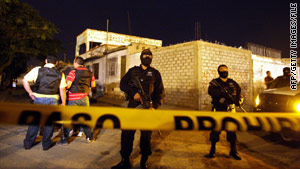
Also, here is a YouTube video of one selection from this last semester's Domenici Conference at NMSU. It's really long but it discusses U.S.-Mexico border issues and is introduced by Janet Napolitano.
And last...but not least....(this one is old but relevant to our class now and what we talked about last week!)
Juarez business leaders petition U.N. for help with drug traffickers
November 13, 2009 -- Updated 0331 GMT (1131 HKT)
The Mexican border city of Ciudad Juarez has surpassed 2,000 homicides this year, figures show.
STORY HIGHLIGHTS
- Juarez Association of Maquiladoras asks U.N. to send peacekeepers to restore calm
- Bloody turf clashes among warring drug cartels have claimed 2,000 lives this year
- Official says U.N. Security Council can only deploy forces for peacekeeping operations
- Unclear whether the United Nations can accept a petition from citizens of a country
(CNN) -- In the Mexican border city of Ciudad Juarez, business leaders are so concerned about spiraling drug cartel-related violence that they have asked the United Nations to send in peacekeeping soldiers to restore calm.
More than 2,000 killings have been recorded this year in Juarez, with a population of approximately 1.5 million people. A bloody turf war between warring drug cartels that started last year has made the city one of the most violent in the world.
A representative from the United Nations Office on Drugs and Crime in Mexico on Thursday rebuffed the business leaders' petition, saying the international peacekeeping forces can only be authorized by the U.N. Security Council for peacekeeping operations, CNN en Español reported.
It was also unclear whether the United Nations, which is made up of member nations, could accept a petition directly from citizens of a country.
Despite the setback, the petition from the Juarez Association of Maquiladoras garnered headlines for what observers perceived as the desperation of the citizens of Juarez.
Maquiladoras are foreign-owned factories that build components of products that are usually exported elsewhere for completion. Juarez, which borders El Paso, Texas, has one of the highest concentrations of such factories.
According to statistics from local prosecutors, Juarez records about 10 murders a day. The bloodiest month this year has been September, with 476 killings reported.
See you guys tomorrow!
In 2005, the federal government launched a plan to build a $6.7 billion virtual fence along the U.S.-Mexico border. But the government has spent only $672 million and plans to cut spending to $574 million next year. The fence was to be completed next year. Now it won't be done before 2014, if at all.
The Associated Press reported:
"Ultimately, the project could be scaled back dramatically, with the government installing virtual fences along a few segments of the nation's 2,000-mile southern boundary but dropping plans for any further expansion, officials said.
" 'The worst that happens is that we have a system which gives us some value but we conclude that it's not worth buying any more of it,' said Mark Borkowski, the government's director of the project at U.S. Customs and Border Protection.
"The first permanent segment of virtual fence -- a 23-mile stretch near Sasabe, Ariz. -- was supposed to be turned over to the Border Patrol by the main contractor, Boeing Co., for testing in January, but the handover has been delayed by problems involving the video recording equipment.
"... Both Boeing and the government officials said the technical problems stemmed from an erroneous belief that the first-of-its-kind virtual fence could be put together relatively quickly by tying together off-the-shelf components that weren't designed to be linked."
Plenty of groups are critical of the Obama administration's cuts to the fence project.This is an image taken by a classmate/friend of mine, Danielle Kuehnel on the Mexico side of the border in Nogales, Sonora (Summer 2007).
Friday, February 5, 2010

Hello.... Hola ..... Bienvenido(a) Welcome !
As I begin a new year, I anticipated to expand my knowledge of what I understand is the Border, the issues, the problems that surrounds our brothers and sisters just across the Rio Grande. Or is it the Rio Bravo? The names of the "twin cities," El Paso,Tx and Cd. Juarez Chihuahua, are very unique in history and culture.
For now these next paragrahps are only a glimpse of the news stories that are shared with the world. Please feel free to share your opinions.
zara~
@@@@@@@
As I begin a new year, I anticipated to expand my knowledge of what I understand is the Border, the issues, the problems that surrounds our brothers and sisters just across the Rio Grande. Or is it the Rio Bravo? The names of the "twin cities," El Paso,Tx and Cd. Juarez Chihuahua, are very unique in history and culture.
For now these next paragrahps are only a glimpse of the news stories that are shared with the world. Please feel free to share your opinions.
zara~
@@@@@@@
Cartoon Reads:
PAN-Your Creation!
PRI-But, You Unleashed it!
The two-main political parties, pointing fingers.... again.....
The massacre of of teenagers killed last saturday in Cd. Juarez, has brought up many more serious concerns with safety and the government's capability to resolve the assassinations with the drug war.
Latest new top stories of the day, today Friday, February 5, 2010...
(where ever you are, I hope you are having a nice one.... )
In other news...
Mientras que en otras noticias...
El Paso Times Reports:
Juárez massacre: Football players, honor student among 16 victims
· By Adriana Gómez Licón and Daniel Borunda / El Paso Times
They were described as good kids, students and athletes. Some played American-style football -- not the typical targets in a drug war.
The massacre of Juárez high school and college students on Saturday created a shock wave that continues to rumble across a city numbed by years of brutal and unstoppable violence.
Two more victims died at a hospital, officials said Monday, raising the death toll to 16, with 12 others still hospitalized with gunshot wounds. Four remain in critical condition.
On Monday, officials said investigators were questioning a suspect and added that the massacre may be linked to a November shooting in which an El Pasoan was killed.
The dead ranged in age from 13 to 42 years old. At least 11 were teenagers. They were shot late Saturday night when gunmen sealed off a block and stormed into a birthday party in a working-class residential neighborhood in southeastern Juárez and began firing with large-caliber handguns and rifles.
"It is a shame that we are losing so much youth," said Fernando Gallegos Esparza, a football coach in Juárez.
Five of the teens who were shot played on an American-style football team coached by Gallegos Esparza. Two of them died.
· By Adriana Gómez Licón and Daniel Borunda / El Paso Times
They were described as good kids, students and athletes. Some played American-style football -- not the typical targets in a drug war.
The massacre of Juárez high school and college students on Saturday created a shock wave that continues to rumble across a city numbed by years of brutal and unstoppable violence.
Two more victims died at a hospital, officials said Monday, raising the death toll to 16, with 12 others still hospitalized with gunshot wounds. Four remain in critical condition.
On Monday, officials said investigators were questioning a suspect and added that the massacre may be linked to a November shooting in which an El Pasoan was killed.
The dead ranged in age from 13 to 42 years old. At least 11 were teenagers. They were shot late Saturday night when gunmen sealed off a block and stormed into a birthday party in a working-class residential neighborhood in southeastern Juárez and began firing with large-caliber handguns and rifles.
"It is a shame that we are losing so much youth," said Fernando Gallegos Esparza, a football coach in Juárez.
Five of the teens who were shot played on an American-style football team coached by Gallegos Esparza. Two of them died.
********************************
‘Queremos justicia, no más mentiras...’
Rocío GallegosEl Diario
“Queremos justicia, no más mentiras”, gritaron al gobernador José Reyes Baeza Terrazas parientes de los jóvenes masacrados en Villas de Salvárcar, mientras el mandatario realizaba un recorrido casa por casa para ofrecer sus condolencias a las familias de los fallecidos.
A voz en cuello, un grupo de personas le exigió al funcionario estatal que encuentre a los verdaderos culpables de la matanza que tiene ahora enlutadas a 16 familias juarenses.
“El que agarraron, los que dicen que son los asesinos no lo son, queremos a los verdaderos culpables”, clamó con evidente coraje Patricia Dávila, tía de los hermanos Marcos y Luis Piña Dávila, en medio de una protesta que realizaron ayer sin importar la lluvia que en esos momentos arreció.
La mujer explicó que su apreciación se basa en el tipo de arma que la autoridad señala como la usada en ese hecho y las heridas recibidas por los fallecidos y lesionados.
‘Queremos justicia, no más mentiras...’
Rocío GallegosEl Diario
“Queremos justicia, no más mentiras”, gritaron al gobernador José Reyes Baeza Terrazas parientes de los jóvenes masacrados en Villas de Salvárcar, mientras el mandatario realizaba un recorrido casa por casa para ofrecer sus condolencias a las familias de los fallecidos.
A voz en cuello, un grupo de personas le exigió al funcionario estatal que encuentre a los verdaderos culpables de la matanza que tiene ahora enlutadas a 16 familias juarenses.
“El que agarraron, los que dicen que son los asesinos no lo son, queremos a los verdaderos culpables”, clamó con evidente coraje Patricia Dávila, tía de los hermanos Marcos y Luis Piña Dávila, en medio de una protesta que realizaron ayer sin importar la lluvia que en esos momentos arreció.
La mujer explicó que su apreciación se basa en el tipo de arma que la autoridad señala como la usada en ese hecho y las heridas recibidas por los fallecidos y lesionados.
***************************
10 alleged members of drug ring arrested
Daniel Borunda / El Paso Times
Posted: 02/04/2010 12:00:00 AM MST
Mexican authorities arrested 10 members of a drug cell in the Valley of Juárez working for the cartel of Joaquin "El Chapo" Guzmán, officials said Wednesday.
The cell, including lookouts at young as 14, is allegedly responsible for killings in a war against the Juárez drug cartel, including three unidentified men found in a narcofosa, or narco-grave, on Monday in the desert near the village of San Isidro.
The cell was allegedly run by Fernando "El Popeye" González Ordaz, 34.
**********************************
***************
Tucson (USA), 26 ene (EFE) .- A new pilot program at the Arizona border allows Mexican citizens who traffic in drugs should be tried in his country with the evidence obtained by U.S. authorities.Kevin Kelly's agent in charge of the office of U.S. Immigration and Customs Enforcement (ICE by its initials in English) in the city of Nogales, Ariz., told Efe that this is the first initiative of its kind on the border between the United . UU. and Mexico and is valid only at the DeConcini port of entry in this city."This program only applies to Mexican citizens, not naturalized persons or persons with legal residence in the U.S.," said federal agent.
******************
Los Angeles, Jan 28 (EFE) .- A Mexican fugitive was extradited by the authorities of his country to the United States to face trial for the death of a Border Patrol agent, in January 2008, authorities said MondayAccording to the indictment, Jesus Navarro Montes, 24, intentionally ran his Hummer Aguilar, 31, and six as a member of the patrol, when he tried to arrest him on suspicion of drug trafficking near the Calexico-Mexicali border crossings.Representatives of the prosecutors reported today that Navarro was taken to Houston and from there will be transferred to the custody of the Attorney in the Southern District of California.The suspect had been arrested earlier in Mexico, near Mexicali, but was released in June 2008 on the grounds that there was no international arrest warrant, which led the protest of the U.S. authorities.Navarro was recaptured in February 2009 by authorities in Mexico, with the help of the Federal Bureau of Investigation (FBI) and the Prisoner Custody Service (U.S. Marshals).If convicted, the suspect could be sentenced to 40 years in prison for drug trafficking and life imprisonment for the murder of the agent, said prosecution spokeswoman.
**************************
Tucson (Arizona), 30 ene (EFE) .- Arizona Congresswoman Gabrielle Giffords said in an interview with Efe that is necessary to support existing security programs that are working to stop the flow of migration and drug trafficking. "We know that drug trafficking and illegal immigrants is a multibillion-dollar industry that is increasingly dangerous and violent so I think we should support the resources we already have and make sure we have the necessary funds," he said.According to Democratic Representative District 8, which includes portions of the border with Mexico, it must use "smart security" to secure the border by combining technology, surveillance and enforcement of immigration laws inside the U.S..He argued that last week visited the temporary checkpoint of the Border Patrol on Interstate 19, which the Federal Government has just awarded him $ 1.5 million for its expansion.The Tucson sector Border Patrol, which covers 90 percent of the Arizona border, is the only sector of the federal agency does not have a permanent checkpoint."During the day I visited the Border Patrol had a major drug seizure at the checkpoint, then we realized its effectiveness," he said.But residents of nearby communities are opposed to the temporary checkpoint to be permanent, arguing that affects tourism and create a greater presence of groups of illegal immigrants and traffickers in their fields who seek alternate routes to avoid agents border.The temporary checkpoint has been operating since 2005 and its renewal is expected to be completed next April.But it was not easy to combine different elements to optimize security and border projects like the virtual fence have faced constant problems to function.The Department of Homeland Security (DHS) expects the system consisting of 17 towers located near the border town of Sasabe, Arizona, began to be operated by the Border Patrol in late 2009.
****************************
HAVE YOU EVER HEARD OF THE "NARCOTRAFICO" MUSEUM?
CHECK OUT THE FOLLOWING LINKK TO FIND OUT MORE...
*********************************************************************
Mexico's account of deaths linked to the drug war this year has now exceeded more than one-thousand people, in only 34 days according to the recount published by the local newspaper, El Universal.
México supera barrera de los mil muertos por narcotráfico en lo que va de año
La violencia del crimen organizado en México se ha saldado ya con la muerte de más de mil personas en lo que va de año, cifra que se alcanzó en tan solo 34 días, según un recuento periodístico que publica el diario El Universal.
Cuerpos baleados en la orilla de la carretera en Ciudad Juárez. - EFE Ser guardaespaldas, un negocio en México Jueces, nuevo objetivo de los narcos Narco museo en México
La violencia del crimen organizado en México se ha saldado ya con la muerte de más de mil personas en lo que va de año, cifra que se alcanzó en tan solo 34 días, según un recuento periodístico que publica el diario El Universal.
Cuerpos baleados en la orilla de la carretera en Ciudad Juárez. - EFE Ser guardaespaldas, un negocio en México Jueces, nuevo objetivo de los narcos Narco museo en México
México, (EFE).- La cifra de un millar de asesinados se obtuvo más rápido que en años anteriores, ya que en 2009 se alcanzó en 51 días, en 2008 en 113, 2007 en 134, 2006 en 181, y 2005 en 254, de acuerdo con los datos no oficiales que proporciona ese periódico todos los días.
En Ciudad Juárez, matar es una profesión
En México ninguna autoridad ofrece con oportunidad y regularidad cifras sobre el número total de muertes violentas que ocurren en el país, y tampoco se discriminan las que pueden haber sido ocasionadas por la acción del crimen organizado.
Sólo el Instituto Nacional de Estadística, Geografía e Informática (Inegi) entrega una vez al año datos de homicidios anuales pero con varios meses de retraso, razón por la cual algunos diarios mexicanos cuentan el tipo de muertes que cada uno considera pudieron haber sido ocasionadas por el narcotráfico.
De acuerdo con El Universal, hasta el jueves en México habían sido asesinadas 1.015 personas, de las cuales el 24,3% murieron en el norteño estado de Chihuahua, seguido de Sinaloa (22,5%), Baja California (11,5%), Durango (8,2%) y Guerrero (7,8%).
Según estos cálculos independientes, en México cada 48 minutos una persona pierde la vida en un crimen relacionado con la operación de las organizaciones delictivas y narcotraficantes.
De acuerdo con datos de la fiscalía federal, en los primeros tres años de Gobierno del presidente mexicano, Felipe Calderón, quien asumió el poder en diciembre de 2006, murieron en el país unas 15.000 personas por estos delitos, aunque los periódicos aseguran que la cifra supera los 17.000.
En México operan varias organizaciones narcotraficantes, la mayoría enfrentadas entre sí, entre las que se cuentan los carteles de las drogas de Sinaloa, Golfo, La Familia, Los Zetas, Tijuana y Juárez, entre otros.
Terra/EFE
En Ciudad Juárez, matar es una profesión
En México ninguna autoridad ofrece con oportunidad y regularidad cifras sobre el número total de muertes violentas que ocurren en el país, y tampoco se discriminan las que pueden haber sido ocasionadas por la acción del crimen organizado.
Sólo el Instituto Nacional de Estadística, Geografía e Informática (Inegi) entrega una vez al año datos de homicidios anuales pero con varios meses de retraso, razón por la cual algunos diarios mexicanos cuentan el tipo de muertes que cada uno considera pudieron haber sido ocasionadas por el narcotráfico.
De acuerdo con El Universal, hasta el jueves en México habían sido asesinadas 1.015 personas, de las cuales el 24,3% murieron en el norteño estado de Chihuahua, seguido de Sinaloa (22,5%), Baja California (11,5%), Durango (8,2%) y Guerrero (7,8%).
Según estos cálculos independientes, en México cada 48 minutos una persona pierde la vida en un crimen relacionado con la operación de las organizaciones delictivas y narcotraficantes.
De acuerdo con datos de la fiscalía federal, en los primeros tres años de Gobierno del presidente mexicano, Felipe Calderón, quien asumió el poder en diciembre de 2006, murieron en el país unas 15.000 personas por estos delitos, aunque los periódicos aseguran que la cifra supera los 17.000.
En México operan varias organizaciones narcotraficantes, la mayoría enfrentadas entre sí, entre las que se cuentan los carteles de las drogas de Sinaloa, Golfo, La Familia, Los Zetas, Tijuana y Juárez, entre otros.
Terra/EFE
Subscribe to:
Posts (Atom)